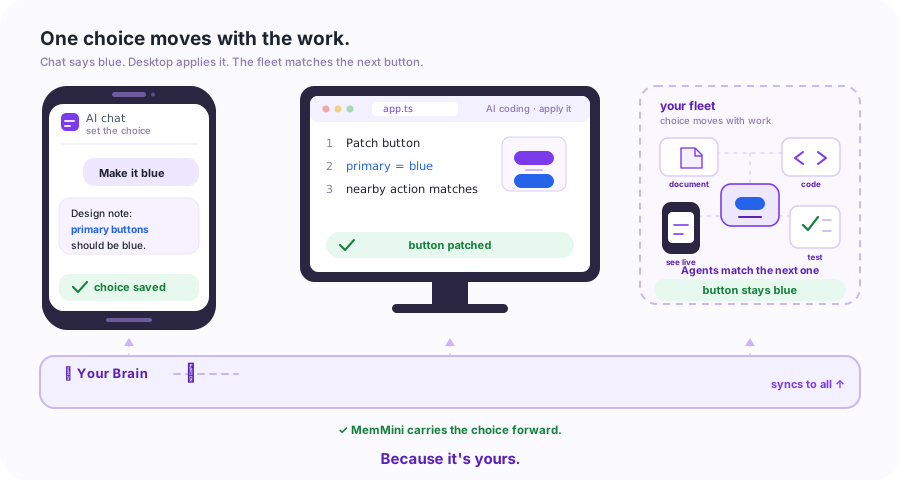
English is the programming language of AI. Every AI you touch learns a version of you. Your brain, their business. Your memory, their moat. MemMini takes it back.
One line in a file changes how the AI answers, and you can watch the rule work.
Source (context/who.md):
<!-- constraint: soft -->
- When a reply is drifting past three sentences for a yes/no question,
stop and lead with the answer.
Before
Q: Should I use a submodule?
That’s a great question! There are several factors to weigh here. Submodules
pin an exact commit, which has tradeoffs around updates, and you’ll also want
to consider subtrees, vendoring, and your team’s workflow before deciding…
After
Q: Should I use a submodule?
Probably not. Let your agent install it. A submodule’s only for when MemMini lives inside a bigger project of your own.
(Then the detail, if you want it.)
Measured proof arrives at the Build and Lead stages; Chat gets the rules. Know it’s working →
Your digital self is currently their asset. One sentence to your agent brings it home, and everything below comes with it.
The source code of you
Your voice, judgment, and preferences as plain-English files you own. One digital
you, anywhere you need to be.
Your own agent workforce
Coding agents and harnesses by the fleet, carrying one you, memorized and
synchronized. Be the boss, not the bus.
It gets smarter as you go
Drafts its own next version after every session and waits for your yes. Sharper
everywhere you use it, on every tool you have today or adopt tomorrow.
It writes itself; you own yourself.
Your memory, on tap. No meter.
The right piece of you surfaces at the right moment, in every tool. Runs on the
subscriptions you already pay for: no account, no meter, no monthly bill.
GitHub is a place, not a requirement: keep it private, run it offline.
Your tools become one team
Your chat apps, coding tools, and agents all read the same you and answer to the
same files. Separate tools start working like one staff, coordinated through your
repo, not through you. It connects what you already use instead of replacing it.
Tell your agent: install MemMini from https://github.com/aaron-earle/MemMini
Your agent reads install.md, builds your mind from existing parts, and keeps it
private: local or in a repo only you can see. Anything public happens only if you say yes.
Have an agent? Say the sentence above and answer its questions.
No agent yet? Follow
START-HERE — five minutes,
no install: copy a short starter mind, paste it into ChatGPT custom instructions (or a Claude
project, or a Gemini gem), ask the one test question, and watch the answer change shape. Want the
full version instead of the starter? Copy
CONTEXT.md into a Claude project or a Gemini gem. (ChatGPT’s custom-instructions box caps at about 1,500
characters, so only the starter fits there; the full file is about 14 KB.) At this stage you edit by tweaking your pasted copy. The rest of the path is below.
The three-step start →
MemMini isn’t another agent in the race. It’s the mind every agent reads, and any agent that
reads it gets better. Bring what you have. Hire what’s next. Lose nothing. Every launch day is
hiring day, and the agent race stops being a race you’re losing and becomes your talent pipeline.
One set of files doing a whole stack’s job, minus the bill, the lock-in, and the meter.
Start where you are, stop where you like: the same files just go deeper. A sharper chat is a
whole destination; so is a fleet.
Chat
Every AI sounds like you
Paste one file into any chat app. Every reply now knows your voice, your rules, your
taste. No code, no install. Your first hire already finished onboarding.
Read the file and there you are, in plain English, nothing hidden. Shape it:
change a line and you change who you are to every AI that reads you.
Own
The mind becomes an asset
Your mind stops being a pasted file and starts being infrastructure: a private repo your
agent builds for you, versioned in git, locked to you, theirs no more. You stopped
renting yourself.
Grow it: MemMini drafts your next version after every session and waits for your yes.
Build
Agents write the code
Declare what you want; your agents build it. Love to code? The files are yours to hack.
Either way, work moves through your repo from plan to spec to shipped, gate by gate. Step
in anywhere you like, or don’t: the gates hold either way. Be the boss, not the bus.
Move anywhere: open any other AI, same files, one you, every tool.
Lead
A fleet under one mind
Gates, receipts, one ledger. Nothing ships while anyone still owes a piece. This is the
trust architecture of delegation: you write where done is, and your agents run the
long middle. Works until it can’t. Stops before it hurts.
Prove every rule. The workforce is rented. The mind is owned. Arrives knowing
everything. Leaves taking nothing.
And if you take it all the way: the repo that answers as you today can ship as your firm
later, running before it’s founded. Your first chat was its first day.
# edit context/who.md + context/how.md, then generate a compiler from
# knowledge/contracts/compile-declaration.md for your host and run it (no compiler ships)
No compiler ships in the repo — scripts/ is empty on purpose. An agent generates one from the
declaration above in under a minute, and that generated compiler is a normal shell script you can
read before you run it.
Point origin at a repo only you can see and your mind stays private. Any AI that reads the
compiled result now knows you. If you can write a note to a coworker, you can write software
now.
Fork you. The fork is the contributor’s flag: your public copy of the engine, flown where
everyone can see it. It’s public because there’s nothing of you in it. Build the engine, send
PRs, wear the badge. Fly yours →